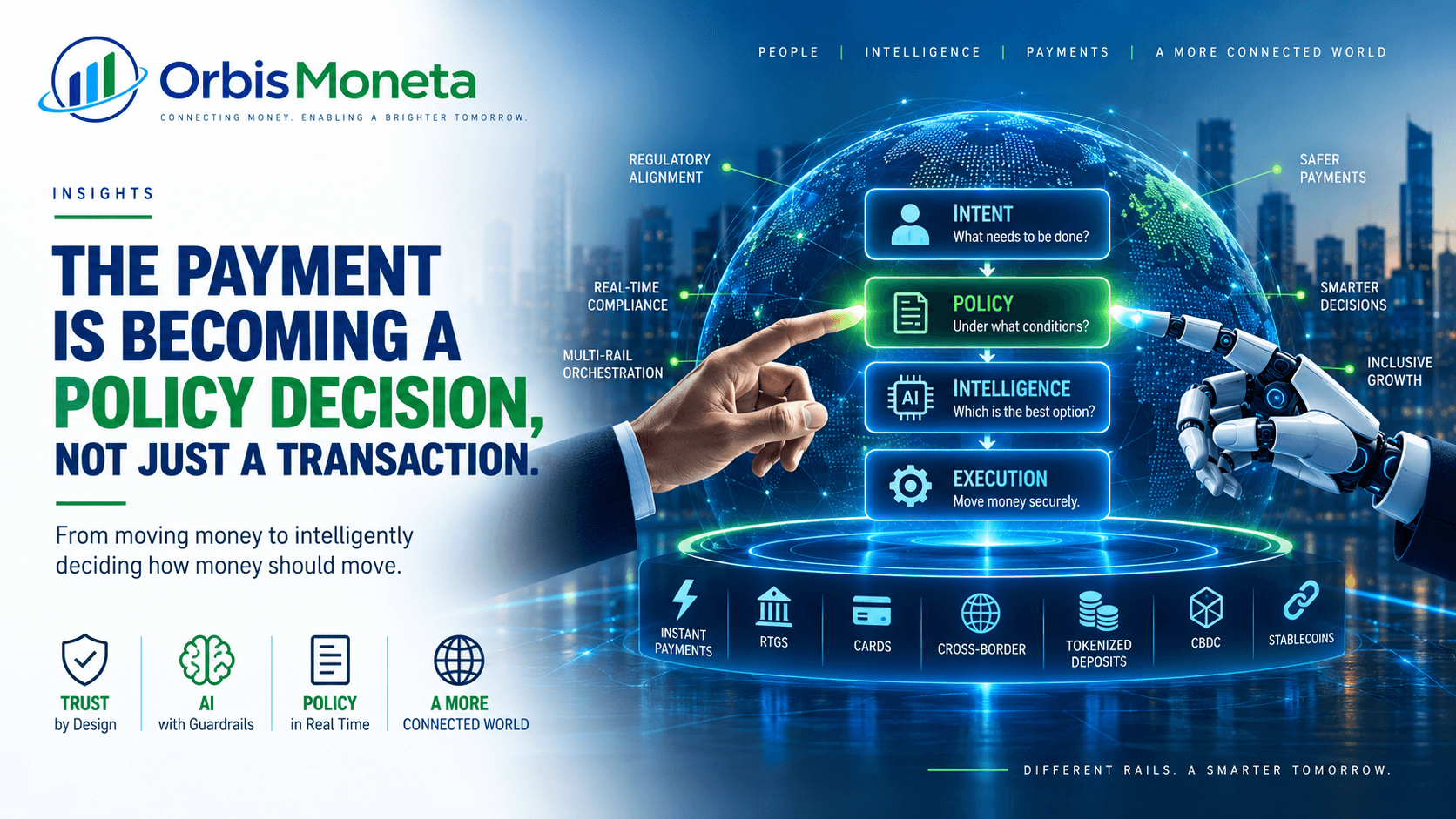
The payment is becoming a policy decision—not just a transaction.
The future payment system will not merely answer "Can this payment be processed?" It will answer "Under what conditions should this payment be processed, through which rail, using which form of money, and with what level of autonomy?"
For decades, the core question in payments was: Can we move the money? Then the industry focused on: How fast? How cheaply? How securely? The next question will be fundamentally different: Should this transaction happen—and if so, under what conditions? This shift is being accelerated by AI agents, tokenized money and increasingly programmable payment infrastructure. Consider an AI agent acting on behalf of a corporate treasury team. It doesn't simply send a payment instruction. It may decide:
- Which supplier to pay
- When to pay
- Which currency to use
- Which FX route to select
- Which payment rail to use
- Whether liquidity is sufficient
- Whether the transaction complies with policy
- Whether the transaction requires human approval
The payment becomes the final output of a decision process. And that changes the architecture.
Today's model
Instruction → Authentication → Authorization → Payment → Settlement Emerging model Intent → Identity → Policy → Risk → Liquidity → Routing → Authorization → Settlement The difference is profound.
AI is making this real
In March 2026, Santander and Mastercard demonstrated a live end-to-end payment executed by an AI agent within a regulated banking framework. The transaction operated within predefined permissions and controls. By June, Mastercard had introduced Agent Pay for Machines, explicitly addressing programmatic, high-frequency and potentially micro-value transactions between machines and services. Its architecture includes credentialing, permissioning, transaction orchestration and multi-rail settlement. This is more important than another AI-payment announcement. It signals that the payment participant itself is changing. The participant may no longer be only: Person → Merchant It can become: Agent → Service Agent → Agent Enterprise Agent → Supplier Treasury Agent → Liquidity Venue And eventually: Machine → Machine → Machine
This creates a new infrastructure requirement
A Financial Policy & Orchestration Layer Such a layer would sit between financial intent and settlement. It would continuously evaluate: Identity Who is acting? Authority What has the agent been permitted to do? Intent What outcome was requested? Policy What conditions must be satisfied? Risk Is the transaction anomalous? Liquidity Can it be funded efficiently? Routing Which payment rail is optimal? Settlement Which form of money should ultimately settle the transaction? This last question becomes particularly interesting as tokenized deposits, CBDCs and other digital settlement mechanisms develop. The Eurosystem's March 2026 strategy recognizes this convergence: its approach spans traditional payment infrastructure, tokenisation and DLT while maintaining central bank money as the anchor of trust and stability.
The payment rail may become an execution choice
Imagine the same enterprise payment being evaluated by an intelligent orchestration layer. For one transaction: Instant Payment For another: RTGS For another: Tokenized Deposit + Central Bank Money For another: Cross-Border Network For another: Stablecoin settlement The decision could depend on: Value + urgency + liquidity + currency + counterparty + risk + regulation + settlement finality The customer shouldn't have to understand this complexity. The infrastructure should. This is why I believe the strategic opportunity is moving beyond payment modernization toward financial orchestration.
The bigger transformation
The bigger transformation We often describe AI in banking as a productivity opportunity. I think that undersells it. AI could eventually become a decision layer for financial infrastructure. But AI should not have unrestricted control over money. The architecture should instead establish a hierarchy: Human / Enterprise Defines objectives, risk appetite and delegation. ↓ AI Agent Interprets intent and proposes or executes actions. ↓ Financial Control Plane Enforces identity, authority, policy, risk, compliance and liquidity rules. ↓ Payment Orchestration Selects rail, currency, routing and settlement mechanism. ↓ Financial Infrastructure Executes and settles the transaction. This separation could become one of the most important design principles for the next generation of banking platforms.
Our View
The biggest mistake would be to treat agentic payments as simply "adding AI to payments." That approach misses the architectural transformation. The more important opportunity is to create a trusted financial control plane capable of governing autonomous financial activity across multiple rails and forms of money. That would allow banks to move from: Payment processing to Financial decision orchestration and ultimately toward: Autonomous financial execution—with human-defined boundaries.