
The GenAI Wall Effect
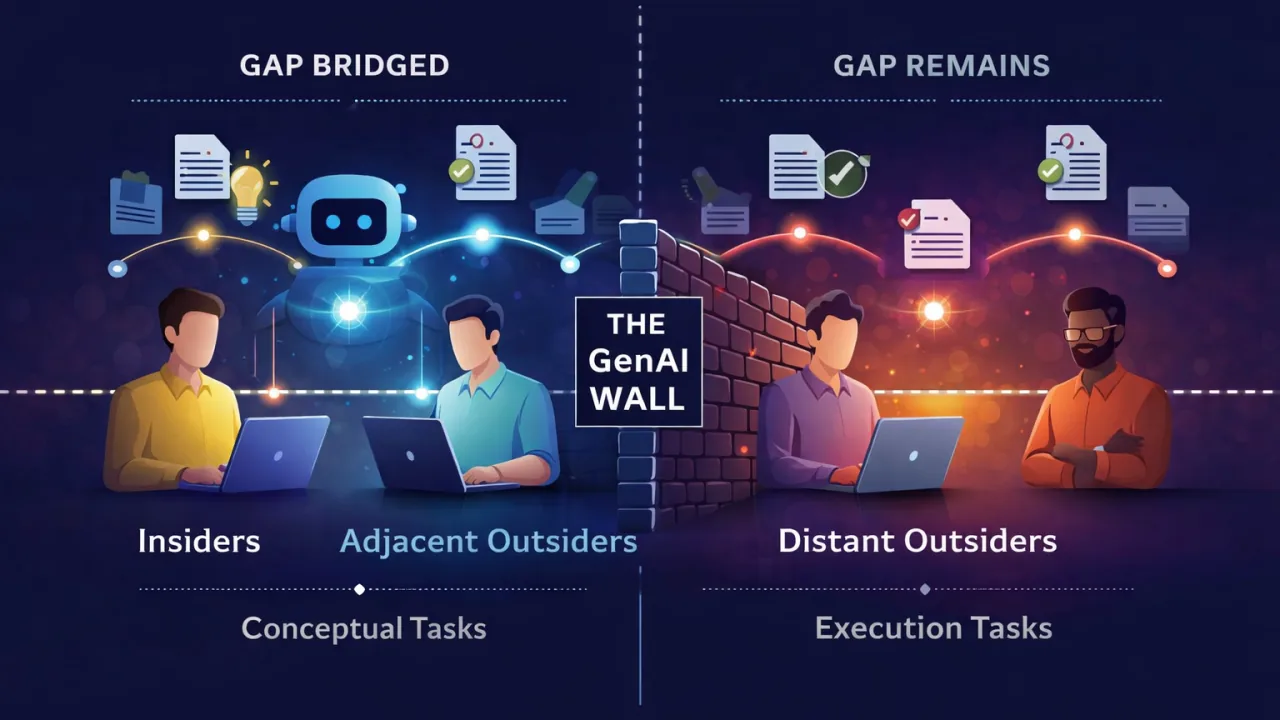
GenAI can narrow expertise gaps — but it cannot eliminate them. At a certain point it hits a wall, and where that wall stands decides how far anyone can work outside their own domain.
Why Artificial Intelligence Won't Replace Expertise — But Will Redefine It
In boardrooms across banking, fintech, and technology firms, a familiar narrative is taking hold: Generative AI will democratize expertise. The assumption is simple — if AI can generate high-quality outputs, then the barriers between specialists and non-specialists will dissolve.
A recent working paper from Harvard Business School, “The GenAI Wall Effect: Examining the Limits to Horizontal Expertise Transfer Between Occupational Insiders and Outsiders,” challenges that assumption with compelling evidence.
The research reveals a more nuanced reality: GenAI can narrow expertise gaps — but it cannot eliminate them.
At a certain point, it hits a wall.
Beyond the Hype: What the Research Shows
The study, conducted in collaboration with a large global fintech firm, examined whether employees from different professional backgrounds could perform specialized tasks using GenAI.
Participants were divided into three groups:
- Insiders: domain experts already performing the task
- Adjacent outsiders: professionals with related skillsets
- Distant outsiders: professionals from unrelated domains
All were asked to perform two types of tasks:
- 01Conceptualization (ideation, structuring content)
- 02Execution (developing full, polished outputs)
The findings were striking.
GenAI as an Equalizer (Conceptual Tasks)
- Non-experts were able to match expert performance
- Output quality improved significantly across all groups
- Even lower performers caught up with top performers
GenAI as a Limiter (Execution Tasks)
- Only adjacent professionals (e.g. marketing specialists) matched experts
- Distant professionals (e.g. technologists) failed to close the gap
This phenomenon is what the authors define as the “GenAI Wall.”
Understanding the GenAI Wall
The GenAI Wall represents the limit of AI's ability to compensate for lack of domain expertise.
It emerges due to two key factors.
1. Knowledge Distance
The greater the gap between a person's existing skills and the target task, the harder it becomes to leverage AI effectively.
- Close domains: AI bridges the gap
- Distant domains: AI struggles to compensate
2. Task Nature
Not all work is created equal:
- Conceptualization: abstract, pattern-based, AI excels
- Execution: contextual, judgment-driven, AI struggles
As the study highlights, execution is not merely an extension of ideation — it is an act of embodiment, requiring tacit knowledge, contextual awareness, and decision-making finesse.
A New Lens: Vertical vs Horizontal Impact
Most discussions around AI focus on vertical impact — how AI affects performance within a role (e.g. helping junior employees catch up).
This research introduces a more disruptive dimension: horizontal impact. Can AI enable people to perform jobs outside their domain?
The answer is: partially.
- AI can enable adjacent role mobility
- But it cannot fully enable cross-domain transformation
This distinction is critical for organizations redesigning their workforce strategies.
Implications for Banking, Fintech, and Digital Payments
For industries like banking and payments — where domain knowledge is deeply embedded — this insight has profound implications.
1. Rise of Cross-Functional Capability
GenAI will enable professionals to operate across adjacent domains:
- Payments to digital assets
- Product to AI-led design
- Operations to automation strategy
However, core domains like risk, compliance, and settlement logic will remain expertise-driven.
2. Redefining Expertise
The value of expertise is shifting from procedural knowledge (how to do tasks) to:
- Foundational understanding (why things work)
- Contextual judgment (what to do in ambiguity)
- AI orchestration (how to guide machines effectively)
3. The Future Operating Model
Organizations will likely evolve toward:
- AI-assisted execution layers
- Fluid, task-based teams
- Reduced dependency on rigid job roles
Yet, they will still rely on domain anchors — individuals who deeply understand systems, regulations, and business logic.
Strategic Takeaway
The most important takeaway from the GenAI Wall Effect is this:
GenAI democratizes ideation — but execution remains the domain of understanding.
For leaders, this means:
- Investing in AI adoption alone is not enough
- Organizations must also invest in building foundational expertise
- Workforce transformation must balance breadth (AI-enabled) and depth (domain-driven)
Looking Ahead
GenAI will undoubtedly reshape how work is done. It will lower entry barriers, accelerate productivity, and unlock new forms of collaboration.
But it will not flatten expertise entirely.
Instead, it will redefine it.
In the emerging AI-driven enterprise, the winners will not be those who rely solely on AI — but those who understand where AI works, where it fails, and how to operate at that boundary.
That boundary has a name now. The GenAI Wall.