The future of payments is Embedded, Digital and Agentic.
From invisible payments to intelligent financial infrastructure: why the next phase of payments will be defined by context, connectivity and trusted autonomy.
Payments have evolved continuously throughout my career. We have moved from traditional banking channels to internet banking, mobile payments, instant payments and increasingly sophisticated digital financial services. Each transformation has improved how money moves, how businesses operate and how customers interact with financial institutions.
But I believe we are approaching another important shift.
The future of payments will be Embedded, Digital and Agentic.
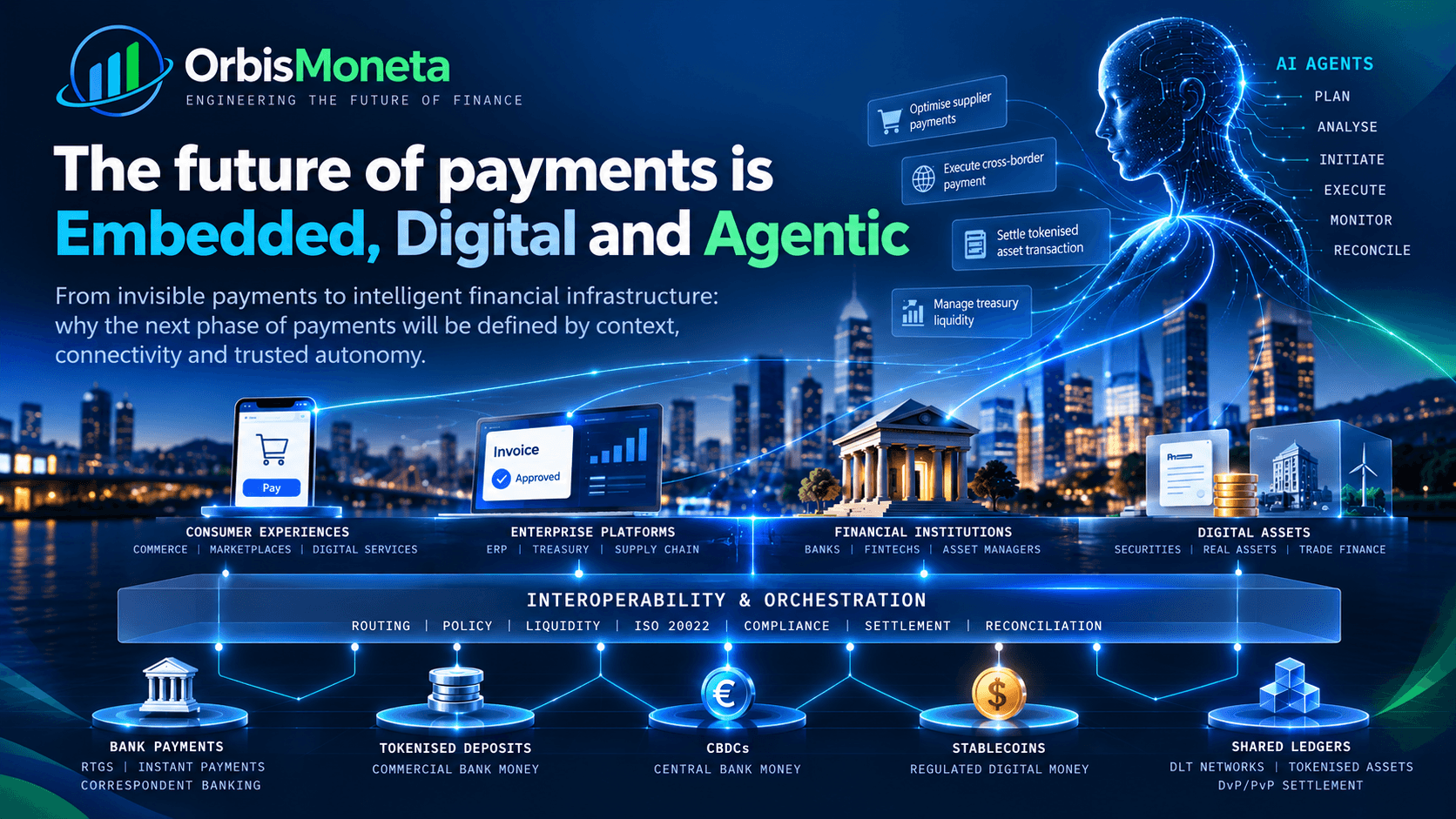
Payments will increasingly become part of the experiences in which we buy, sell, borrow, invest and do business. Money itself will become more programmable, with tokenised deposits, CBDCs and regulated stablecoins creating new possibilities for settlement. And AI agents will begin to make payment decisions and execute transactions within clearly defined permissions and controls.
These are not three independent trends. They are converging to reshape the architecture of financial services.
For banks, fintechs, payment providers and regulators, the question is no longer simply how to process a transaction faster. It is how to build financial infrastructure that can connect business intent, intelligent decisions, different forms of money and multiple payment networks—securely and reliably.
1. Embedded payments: Money moves closer to the activity
The best payment experience is often one in which the payment itself becomes almost invisible.
Consider a business purchasing raw materials. The procurement platform raises an order, checks the supplier, validates the invoice, initiates payment and reconciles the transaction. Ideally, these steps happen within one connected workflow, rather than across disconnected applications and manual processes.
The same principle applies to consumer commerce, insurance, lending, travel and digital marketplaces. Payments are becoming an integrated capability within the underlying service—not a separate activity that customers must navigate.
Industry research reflects this change. ***Worldpay's Global Payments Report 2026 ***found that digital wallets accounted for 56% of global e-commerce spending and 33% of in-person spending in 2025. These figures illustrate how deeply digital payment experiences are embedded in everyday commerce, although wallets are only one part of the broader embedded-payments opportunity.
The next opportunity is to extend embedded payments beyond checkout into the full financial workflow:
- Enterprise: Payments initiated from ERP, procurement and treasury platforms.
- Lending: Disbursements and repayments integrated into lending journeys.
- Trade finance: Payment execution linked to trade documents and contractual milestones.
- Marketplaces: Conditional payments, automated payouts and controlled release of funds.
- Cross-border commerce: Payment, FX and settlement coordinated within a single business process.
My view is that embedded payments will increasingly differentiate platforms by how effectively they connect the underlying financial processes—not simply by how easy they make the payment button to use.
That creates a challenge for banks. As payments originate from more third-party platforms, banks must retain control over authorisation, liquidity, compliance, execution and reconciliation, even when the customer experience sits outside the bank's own channels.
The opportunity is not to own every customer interface. It is to provide the trusted financial infrastructure that makes those experiences work.
2. Digital money: Beyond digital channels to programmable value
We need to distinguish between digital payments and digital money.
A payment initiated through a mobile application may still move conventional commercial-bank money through an existing payment rail. The interface is digital, but the underlying monetary and settlement arrangements may remain unchanged.
Tokenisation takes the conversation further.
Tokenised deposits, central bank digital currencies (CBDCs), regulated stablecoins and tokenised financial assets are creating new ways to represent and transfer value on programmable infrastructure. They introduce the possibility of coordinating payment instructions, asset transfers and settlement conditions within a more integrated process.
Imagine a tokenised bond being transferred only when the corresponding cash leg is confirmed. Or a cross-border transaction coordinating currency exchange and payment settlement across different networks. Or a corporate treasury function managing liquidity across traditional bank accounts and new digital-money arrangements.
These are important possibilities, but their implementation depends on legal finality, governance, liquidity, operational resilience and the ability to connect new platforms with existing financial systems.
The Bank for International Settlements, in its Annual Economic Report 2025, identified tokenisation as a potential foundation for the next generation of the monetary and financial system. Its analysis highlights the opportunity to integrate messaging, reconciliation and asset transfer on programmable platforms, while retaining central-bank money as a trusted settlement asset.
The European Central Bank's Eurosystem Comprehensive Payments Strategy, published in March 2026, similarly supports the development of tokenised settlement assets while maintaining central-bank money as the anchor for wholesale settlement. It envisages tokenised deposits and appropriately regulated stablecoins coexisting with existing payment infrastructure.
The important implication is that the future will not necessarily be built around one form of digital money or one universal ledger.
Commercial banks may issue tokenised deposits. Central banks may provide settlement in central-bank money. Regulated stablecoins may support particular payment and digital-asset use cases. Existing RTGS, instant-payment and correspondent-banking systems will continue to play important roles.
The real challenge is not simply creating new forms of money. It is making them interoperable.
That means enabling different forms of money, operating across different networks and governed by different rules, to work together without fragmenting liquidity, trust or settlement certainty.
3. Agentic payments: From instructions to intent
The third transformation is the emergence of agentic commerce and payments.
Today, most digital payment journeys still depend on a human making a decision, selecting a payment method and approving a transaction. Automation exists, but it generally operates through predefined rules and workflows.
AI agents introduce a different possibility: the ability to interpret intent, evaluate alternatives, make decisions within defined boundaries and coordinate multiple steps towards an outcome.
Imagine a corporate procurement agent that identifies a requirement, compares approved suppliers, checks contractual terms, validates the available budget and prepares a payment. A treasury agent could monitor liquidity, forecast obligations and recommend when funds should move between accounts. A consumer agent could compare travel options and complete a booking within an authorised budget.
Over time, some of these activities may progress from recommendations to supervised execution and, where appropriate, autonomous transactions.
McKinsey's October 2025 report, The Agentic Commerce Opportunity, estimated that agentic commerce could generate up to $3 trillion to $5 trillion in global consumer commerce by 2030. This is a scenario-based estimate, not a guaranteed outcome, but it signals the scale of the opportunity that businesses are beginning to explore.
**McKinsey's Global Payments Report 2026 **goes further in examining the implications for payment infrastructure. It highlights the growing importance of verifiable machine credentials, consent management, dynamic payment routing and automated policy enforcement as software agents increasingly participate in transactions.
For the payments industry, this raises an important question: If an AI agent can decide when and how to initiate a transaction, what ensures that the transaction is legitimate, authorised and settled correctly?
The answer cannot be intelligence alone.
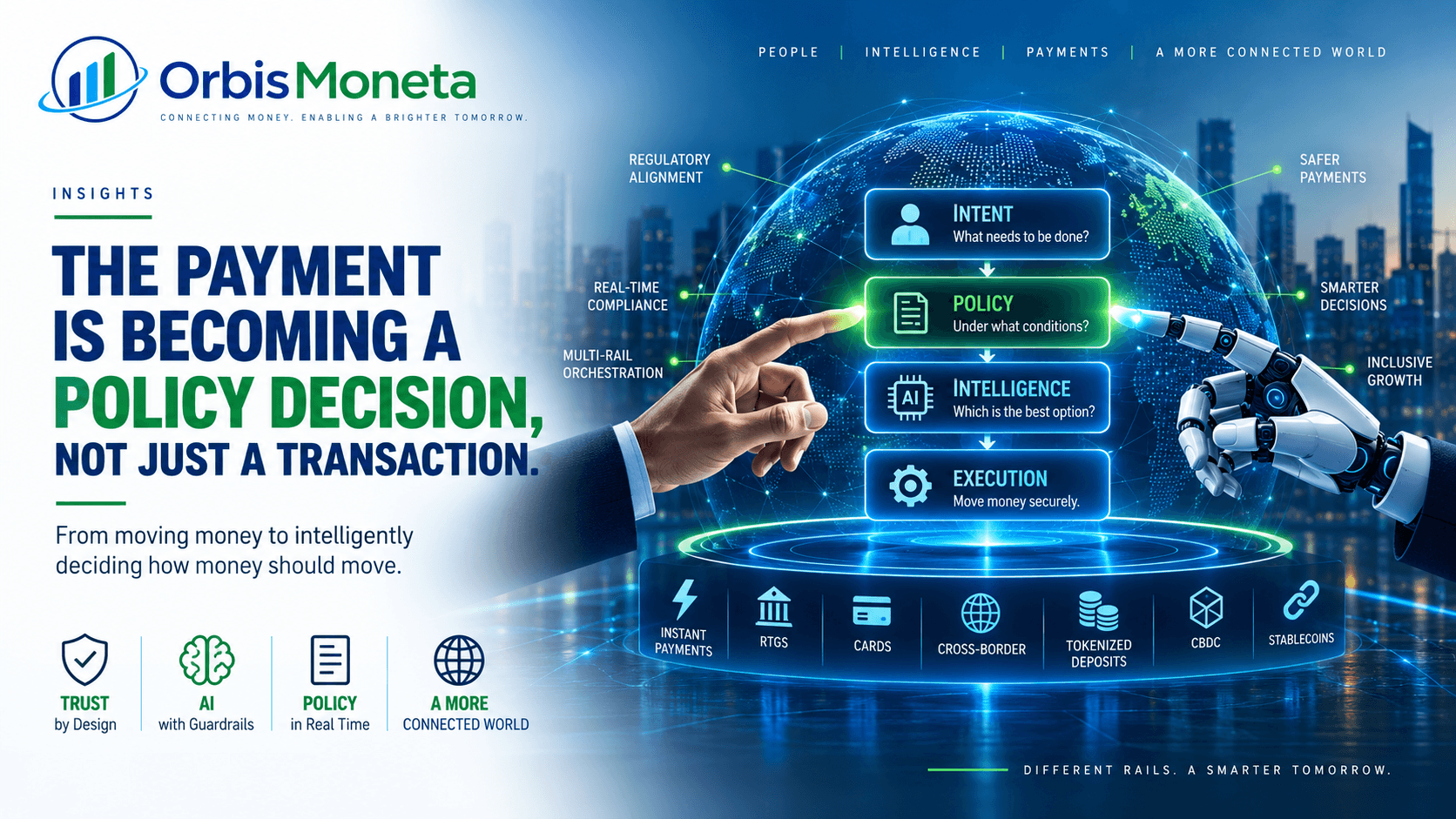
An agent must operate within a clearly defined mandate. The system must establish whose authority it represents, which accounts it can access, what limits apply, which counterparties are eligible and when human approval is required.
Consider a treasury agent instructed to optimise liquidity. It might identify idle balances and recommend moving funds to meet an upcoming obligation. But the execution layer must still validate account ownership, available liquidity, transaction limits, counterparty eligibility and the applicable approval policy.
The same principle applies to consumer payments. Delegating a task to an AI agent should not mean giving it unrestricted authority over a person's money.
Agentic payments will require trusted autonomy: intelligence to make decisions, infrastructure to execute them, and controls to keep those decisions within authorised boundaries.
This is where banks have an important role. Their experience in identity, authorisation, risk management, payment execution and financial accountability will remain essential, even as the interface to financial services changes.
4. The convergence: Embedded, digital and agentic
These three developments are often discussed separately. I believe their real significance becomes clearer when we look at how they reinforce one another.
- Embedded payments bring financial transactions into business and consumer workflows.
- Digital money creates new ways to represent, transfer and settle value.
- Agentic systems help determine when, how and under what conditions transactions should occur.
Together, they create the possibility of a financial ecosystem in which a transaction can originate within a business application, be evaluated by an authorised AI agent, use an appropriate form of digital money and settle across the relevant payment infrastructure—with controls and confirmation throughout the process.
Consider a cross-border supplier payment.
An enterprise system identifies an approved invoice. An AI agent checks the payment deadline, contractual terms, available liquidity and authorised limits. The payment platform evaluates available routes based on currency, cost, speed, counterparty and settlement requirements. The transaction then moves through the selected bank or payment network, with status updates and reconciliation returned to the enterprise system.
In a more advanced scenario, the underlying transaction might involve tokenised deposits, a regulated stablecoin or a tokenised asset. The appropriate choice would depend on the use case, legal framework, liquidity and settlement requirements—not simply on which technology is newest.
This is where the infrastructure challenge becomes significant.
The originating application, AI agent, bank, payment hub, digital-money network and settlement system may all operate on different platforms. They may use different interfaces, data formats, operating windows and control frameworks.
Without effective interoperability, the result could be a new generation of disconnected financial ecosystems.
The Bank for International Settlements has repeatedly highlighted interoperability and operational resilience as prerequisites for scaling tokenised financial infrastructure safely alongside existing systems. Its 2026 Annual Economic Report emphasises the need for coordinated development, strong governance and compatibility with established financial arrangements.
This reinforces a point that has long mattered in payments modernisation: creating another rail is relatively easy to describe; making it work reliably with everything around it is the harder problem.
5. What should banks and financial institutions do now?
I see five priorities for institutions preparing for this next phase.
1. Modernise for a multi-rail environment. Payment architecture should support traditional banking rails, instant payments and emerging digital-money networks through reusable integration and orchestration capabilities. Every new payment method should not require a separate operational stack.
2. Treat digital money as a strategic capability. Banks should assess tokenised deposits, CBDCs and regulated stablecoins in terms of their legal characteristics, settlement finality, liquidity implications and relevant use cases. Technology selection should follow business and regulatory requirements.
**3. Embed payments into business workflows. **Connect payment execution with ERP, procurement, lending, treasury and commerce platforms. The objective is to reduce unnecessary hand-offs while retaining appropriate controls and visibility.
**4. Prepare for controlled agentic execution. **Establish machine identity, delegated authority, consent, transaction limits, policy enforcement, fraud monitoring and audit trails before allowing AI agents to execute payments autonomously.
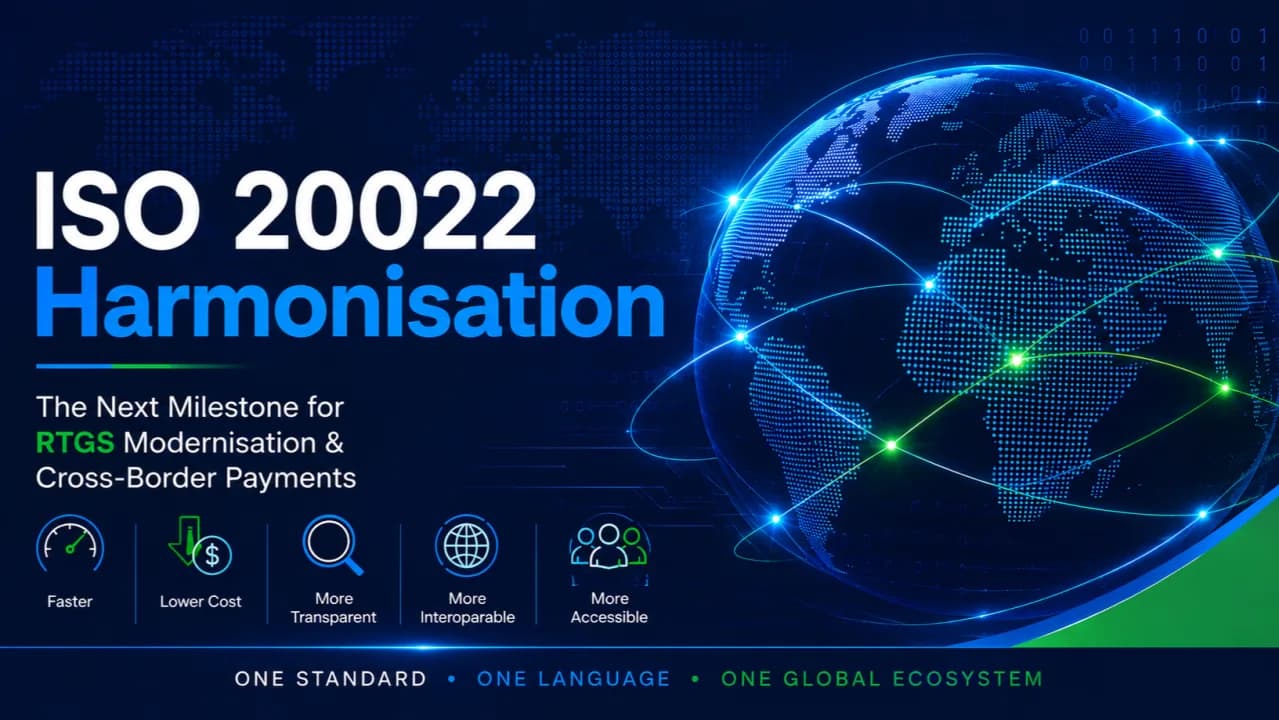
5. Make interoperability a design principle. Build for coexistence between existing core banking systems, payment hubs, ISO 20022 messaging, RTGS, instant-payment systems, shared ledgers and digital-money platforms. Settlement, compliance, reconciliation and exception handling must be considered across the complete transaction lifecycle.
These priorities are connected. Embedded payments create more points of initiation. Agentic systems create more dynamic decisions. Digital money introduces additional settlement possibilities. All three increase the importance of an infrastructure that can coordinate transactions across systems without compromising trust.
Conclusion: The future is not another payment rail
Having worked across payments, banking infrastructure and modernisation, I believe the next phase will be defined less by the introduction of another payment instrument and more by how effectively financial infrastructure connects the entire transaction lifecycle.
Embedded payments will make financial services part of everyday business and consumer experiences. Digital money will expand the ways value can be represented and settled. Agentic systems will increasingly help decide when and how transactions should happen.
But none of these developments can deliver their full potential in isolation.
The real opportunity lies in connecting the point where a payment originates, the intelligence that determines what should happen, the form of money used, the network that processes it and the infrastructure that confirms settlement.
At OrbisMoneta, this is the problem we are working to address through our Financial Interoperability Fabric (OMIF). Our vision is to connect existing payment rails, banking infrastructure, CBDCs, tokenised deposits, regulated stablecoins and emerging digital-asset networks through a reusable interoperability and orchestration layer.
The objective is not to replace established financial infrastructure or introduce another standalone payment network. It is to help financial institutions connect today's payment systems with tomorrow's digital-money ecosystem—securely, intelligently and with the controls required for institutional adoption.
I believe the next generation of financial infrastructure will be defined by its ability to make different systems work together, not by its ability to operate in isolation.
The future of payments is Embedded, Digital and Agentic. The infrastructure that connects it all will be just as important as the innovations themselves.
Industry references and further reading
- Bank for International Settlements (2025) —
Annual Economic Report 2025, Chapter III: The next-generation monetary and financial system. Tokenisation, programmable platforms and the role of central-bank money.
- Bank for International Settlements (2026) —
Annual Economic Report 2026 - Trust, interoperability, operational resilience and the integration of tokenised rails with existing systems.
- McKinsey & Company (2025) —
The Agentic Commerce Opportunity - The emerging role of AI agents in commerce.
- McKinsey & Company (2026) —
Global Payments Report 2026
- European Central Bank (2026) —
The Eurosystem's Comprehensive Payments Strategy - Tokenised settlement assets, wholesale payments and existing infrastructure.
- Worldpay (2026) —
Global Payments Report 2026 - Digital payment adoption and evolving payment preferences.